
Booking a Studio Without Wasting Time or Money

You've got a shoot date, a client waiting for confirmation, and a producer asking for the studio address. The temptation is to call the first space that says it's available. That's how a simple booking turns into a cramped load-in, an extra overtime charge, or a set that can't support the camera movement your director planned.
Booking a studio works better as a requirements-first workflow. Define the production, match it to the right zone, confirm what the quote includes, then secure the date with clear paperwork. That process matters in Atlanta, where a space can look suitable in photos but fail once you account for vehicles, prep time, lighting, client holding areas, or the difference between a cyc wall and a finished set.
Why Booking a Studio Goes Wrong Before You Call
A last-minute request often sounds simple: “We need a studio next Thursday for a music video.” That sentence doesn't tell a booking manager whether you need a white cyc, a black stage, a green screen, a realistic room, vehicle access, space for a production office, or enough time to build and strike. It also doesn't say whether the crew needs the studio for the shoot only or for the full day around it.
The problem starts when the calendar leads the conversation. A date is useful, but it isn't a production brief. If you secure an available room before identifying the technical requirements, you may discover later that the space can't handle your lighting plan, your vehicle, your set dressing, or the number of people attending. Those gaps usually appear as change orders, rushed decisions, or overtime.
The availability trap
Suppose a director wants a hospital scene, a clean product setup, and a green-screen insert. A single generic room may technically fit the crew, but it won't necessarily deliver the visual language or reset speed the day requires. Booking the wrong environment forces the team to build what a dedicated set already provides, or to move equipment between incompatible zones.
Encore Film And Music Studio in Atlanta is a useful example of a facility that requires deliberate matching. Its 10,000+ square foot footprint includes white, black, and green cyc walls, multiple production zones, vehicle access, lounges, camera-ready sets, and on-site equipment rentals. Those features create options, but options only save money when they're selected against a real brief.
Key takeaway: Don't ask only whether a studio is free. Ask whether the studio can support the shoot you're actually producing, including prep, load-in, client holding, technical needs, and strike.
How to Define Your Shoot Needs Before You Request Availability
Start with a one-page technical brief. You don't need every creative decision finalized, but you do need enough operational detail for the studio to confirm the right space and identify constraints before anyone quotes a price.
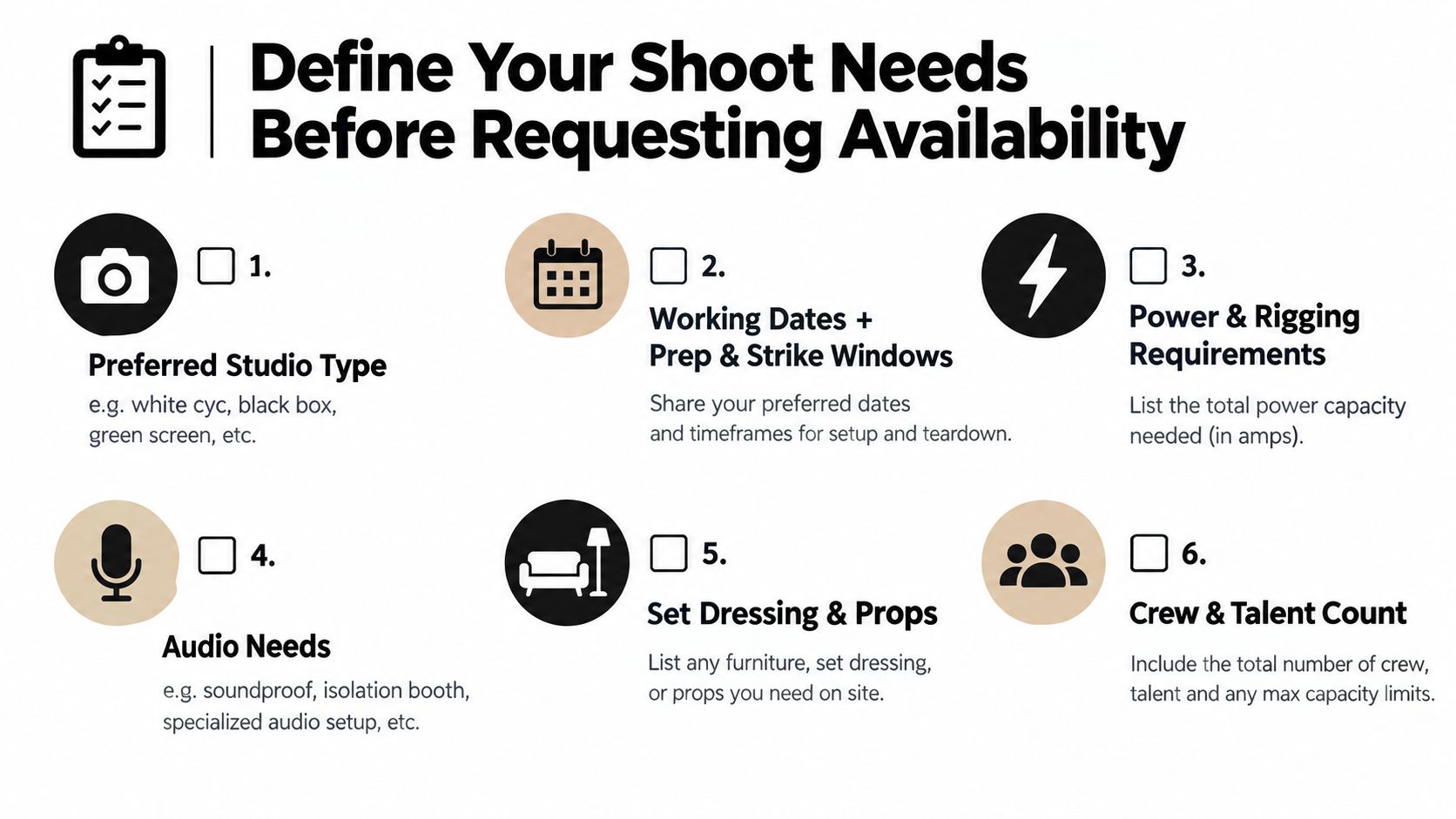
Define the visual environment
Name the studio type first. “Photo studio” is too broad. State whether you need a white cyc, black box, green screen, recording environment, rehearsal space, or a finished practical set. If the project needs multiple looks, list them in shooting order and say whether you expect to reset within the same booking.
Then define the working window. Separate the time for load-in, prep, shooting, meal breaks, and strike. A crew that needs the room from early morning for lighting and set dressing isn't making the same request as a small team arriving shortly before talent.
List technical and access requirements
Be specific about lighting, power, rigging, camera support, audio, connectivity, and vehicle access. Include the type of vehicle, approximate footprint, whether it needs to enter the building or only unload nearby, and how long the load-in may take. If the project involves a car, motorcycle, large props, or heavy cases, vehicle access is a decision filter, not a minor convenience.
Crew size and client attendance matter just as much. Add talent, agency or client representatives, hair and makeup, wardrobe, production staff, assistants, and any visitors. Then identify support areas such as HMU, styling, a production office, a photography area, green room, lounge, or holding space.
A complete brief helps a booking team confirm availability, flag limitations, and price the correct package. The practical guidance in this film studio hire guide follows the same principle: define the technical and logistical requirements before asking for a slot.
Use a copy-ready inquiry
You can adapt this prompt for Encore or any other facility:
Project type: What are we producing, and what visual environments do we need?
Dates: What are the working dates, plus prep and strike windows?
Space: Which cyc, set, or production zone are we requesting?
Crew and talent: How many people will be on site at peak?
Equipment: What lighting, grip, camera, audio, rigging, or rental equipment will we bring or need on site?
Access: Do we need vehicle access, parking, loading support, connectivity, or extended access?
Support spaces: Do we need HMU, wardrobe, styling, client holding, a production office, lounge, or green room?
Commercial terms: What's included, what's extra, and what deposit and cancellation terms apply?
For more space-selection context, review Encore's guide to spaces to rent for filming before sending the inquiry. The more complete the request, the less likely you are to compare quotes that describe different assumptions.
Choosing the Right Zone Cyc Wall and Realistic Set for Your Project
A car that cannot reach the stage, a cyc that cannot support the planned camera move, or a practical set that leaves no room for lighting can create change orders before the first shot. Choose the environment from the requirements outward. The right decision depends on how much control the production needs and how much finished detail the camera needs immediately.
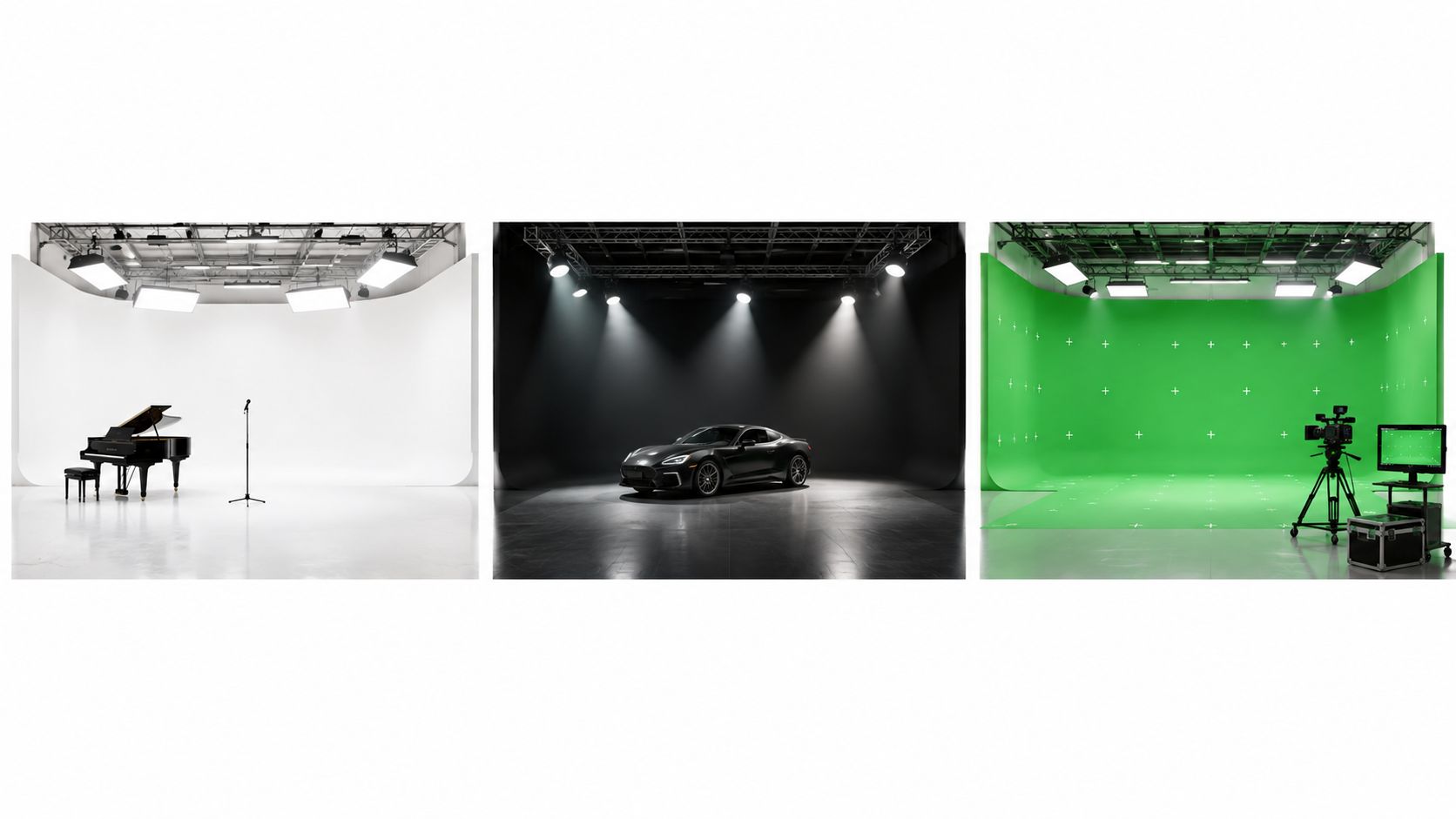
Match cyc color to the image
A white cyc fits clean commercial work, fashion, interviews, product content, and music-video setups where lighting defines the background. It provides an open, polished canvas, but spill, shadows, and the floor-to-wall transition need deliberate control.
A black cyc works for automotive imagery, dramatic portraits, and contrast-heavy scenes. Reflections and light placement become less forgiving, particularly when a subject or vehicle must separate clearly from the background.
A green cyc suits work where the background will be replaced or extended in post. Plan for even screen lighting, clean edges, suitable wardrobe, and enough distance between talent and the screen. Keep the green-screen lighting reference in the pre-shoot checklist section rather than duplicating it here.
Talking-head productions often need controlled lighting, sound, camera position, and background treatment that a home setup cannot provide consistently. The resource on a 2026 talking-head video studio gives creators a useful comparison point when deciding which requirements justify a dedicated production studio.
Choose a finished set when detail saves time
Encore Film And Music Studio's practical catalog includes a hospital recovery room, waiting room, operating room, interrogation room, jail cell, beauty salon and barbershop, conference room, night club, bathroom with shower, elevator, and Gulfstream 800 private jet. These sets can remove separate sourcing for walls, furniture, fixtures, and background dressing.
A hospital scene gains recognizable details without building a room from scratch. An interrogation room or jail cell gives the director a defined frame as soon as the camera is placed. A private jet set can produce a location-specific image without arranging access, permits, or transport for a real aircraft.
Use a cyc when the production needs several backgrounds, broad camera movement, abstract art direction, or fast visual changes. Use a finished set when its built-in detail shortens setup and reduces dressing work. Encore's set selection criteria can help compare the visual requirement with reset time, equipment footprint, and the number of planned setups.
Vehicle access can determine the booking as quickly as the set choice. For a car, large prop, or substantial grip package, confirm the loading route, door dimensions, parking plan, and maneuvering space before holding the date. On-site equipment rentals may reduce transport pressure, but list the equipment early so availability and compatibility are confirmed, not assumed.
Understanding Pricing Packages and the True Cost of Your Booking
The published hourly or day rate is only the starting point. A reliable quote should explain the assumptions behind that rate, including access hours, included equipment, cleaning, staffing, insurance, taxes, and the treatment of overtime.
Encore offers hourly and day-rate reservations, everyday low rates, and special pricing plans for independent creators. Those options are most useful when the inquiry clearly states the production requirements. A lower headline rate doesn't help if the team has to add another booking block because prep was excluded or pay for equipment that wasn't available on arrival.
Compare the line items
Hidden fees commonly come from overtime, extra cleaning, mandatory insurance riders, missed load-out penalties, service fees, and taxes. Recent rental guidance warns that these additions can total 20% or more of the published price (movie studio rental cost guidance). Treat that as a budgeting risk to investigate, not an automatic surcharge on every Encore booking.
Before signing, ask four direct questions: What exactly is included in the rate? What triggers overtime? Which insurance and permit documents are required? What happens if the crew finishes late or cannot complete load-out within the booked window?
How to Handle Deposits Contracts and Booking Confirmation Like a Pro
A booking isn't secure because someone said “we should be able to hold that date.” It's secure when the studio has confirmed the space, the payment terms are understood, and both sides have a written record of the production assumptions.
Read the commercial terms line by line
Check the deposit amount, whether it's refundable, when the balance is due, and what happens if the production changes dates. Review the cancellation window, rescheduling language, damage responsibility, cleaning standards, overtime calculation, and any required insurance rider.
Permits deserve their own check. If the project needs a permit, special clearance, vehicle activity, stunts, weapons, smoke, water, or unusual rigging, confirm who obtains approval and when documents must be delivered. Don't assume the studio's general availability means every planned activity is automatically approved.
Confirm the operational details
Your confirmation email should include:
Booked space: Name the cyc, set, zone, and any support rooms.
Access schedule: Record load-in, prep, shooting, meal, and strike times.
Payment record: Save the deposit receipt, balance date, and cancellation terms.
Production contact: Keep the name and phone number for the person handling arrival and issues.
Access instructions: Confirm parking, loading, codes, keys, elevators, and vehicle routing.
House rules: Share restrictions on nails, paint, smoke, food, rigging, animals, noise, and cleaning.
Documents: Attach insurance certificates, permits, and any special approvals.
Encore's published policies state that a 50% non-refundable deposit is required to secure a reservation. Confirm the current terms directly before payment, especially if your production has a narrow cancellation window or a client approval process.
Contract habit: If a requirement matters to the shoot, put it in the confirmation. Verbal assumptions disappear when the crew arrives.
Your Pre Shoot Checklist for a Smooth Studio Day at Encore
A shoot can lose time before the first shot if the camera plan, client schedule, and load-in plan do not match. Complete the final review before the crew starts driving to the studio. The booking file should connect the creative requirements to the physical setup, including the selected zone, access route, equipment, and working hours.
Before the shoot
Confirm the exact zone, cyc color, practical set, furniture layout, and dressing list. Request current access instructions, then verify crew parking, vehicle unloading, and the route from the loading area into production space. Vehicle access matters when cases, set pieces, or production vehicles are part of the plan.
Review on-site rentals before issuing the call sheet. If the shoot depends on studio lights, grip, stands, audio equipment, or other support, confirm the specific inventory and reserve it in writing. Pack expendables that are easy to miss, including tape, batteries, media, extension solutions, cleaning supplies, wardrobe fixes, and continuity materials.
Add accessibility requirements to the first production conversation. Studio policies may limit bookings to fixed blocks, cap operating hours, require advance notice, or handle accommodations only when requested ahead of time (recording studio booking guidance). Ask about entrances, restrooms, seating, pathways, parking, and support needed by specific talent.
The day before and the day itself
Send the call sheet, studio rules, parking directions, emergency contact, and arrival instructions to every department lead. Confirm who arrives first and who has authority to approve changes. That briefing prevents talent from arriving before HMU is ready and keeps trucks from reaching the property before the loading route is clear.
Run the technical check before talent arrives. Test the camera, audio, capture devices, cyc lighting, power distribution, playback, and any client connectivity. For green-screen work, review this green-screen lighting guide before the lighting team locks the setup.
The supplied preparation video can support that final review:
Keep the work inside the booked time block. Fixed hours and capped access leave little room for a slow load-in, an unplanned reset, or a late client approval. Schedule around the work the crew must complete, and report changes as soon as they appear.
Small teams need the same controls as larger productions. A missed rental, unclear access instruction, or avoidable overtime charge can take a large share of a smaller budget. Book early, keep communication direct, and ask Encore's support team to confirm the zone, equipment, access, and terms before paying the deposit.
Encore Film And Music Studio offers hourly and day-rate space in Atlanta, including white, black, and green cyc walls, practical camera-ready sets, vehicle access, lounges, production zones, and on-site equipment rentals. Visit Encore Film And Music Studio with a technical brief ready, and request space that matches the shoot rather than choosing a room only because it is available.


Comments