
Cyc Wall Rental Guide: Colors, Lighting and Costs

You've got a shot list, a crew chat full of equipment questions, and a studio rate that looks manageable. Then someone asks whether the floor needs fresh paint, whether lighting is included, and when the rental clock starts. Suddenly, the room price isn't the budget anymore.
A successful cyc wall rental depends on matching the background to the finished image, leaving enough space to light it properly, and pricing the whole production day. The expensive mistakes usually happen before recording: choosing a shallow room, treating the wall and talent as one lighting setup, or booking only enough time to shoot.
Which Cyc Wall Color Fits Your Shoot
Choose the cyc color for the final image, not just the mood board. White is a finished background for clean product and fashion work. Black supports subject isolation and deliberate contrast. Green is a production tool for replacing the background later, not a shortcut to a finished scene.
The difference affects crew, equipment, and post-production. A white-background campaign needs controlled brightness without losing pale clothing or product edges. A black-background performance needs carefully contained light. A green-screen shoot needs a compositing plan before anyone arrives.
Cyc wall color by production need
Color | Best for | Key lighting rule | Main risk |
|---|---|---|---|
White | Product, fashion and bright high-key looks | Expose the background above the subject while protecting edges | Reads gray if underexposed; excessive wraparound erodes edge detail |
Black | Portraits, music videos and contrast-heavy work | Keep light off the wall so it stays dark and clean | Stray light lifts the wall and muddies contrast |
Green | Chroma-key compositing | Light the wall separately and maintain uniform exposure | Spill and uneven exposure make the key unstable |
Choose for wardrobe and movement too
White clothing against white doesn't automatically disappear, but it demands separation through shape, texture, and controlled shadows. Don't solve weak separation by turning every fixture up. Check whether the subject needs a different key direction, negative fill, or a more deliberate edge.
For black, watch glossy props and reflective wardrobe. The background may disappear while a polished instrument reflects a softbox, an exit sign, or the crew. Frame and light the reflections deliberately rather than assuming a dark wall hides everything.
Green requires a wardrobe review. Green garments, transparent accessories, loose hair, and reflective surfaces can complicate extraction. Share references with the compositor so the lighting supports the replacement environment rather than creating a beautiful foreground that won't belong in it.
Decision rule: Book green when the background will be replaced, white when the image needs to read clean and graphic, and black when the composition depends on shadow.
Finally, include floor cleanliness in the color decision. A scuffed white floor can photograph as a dirty gray patch even when the wall looks clean. Keep street shoes and equipment traffic outside the shooting area, clean footwear before takes, and designate a crew member to inspect the floor between setups.
How a Cyc Wall Creates a Seamless Background
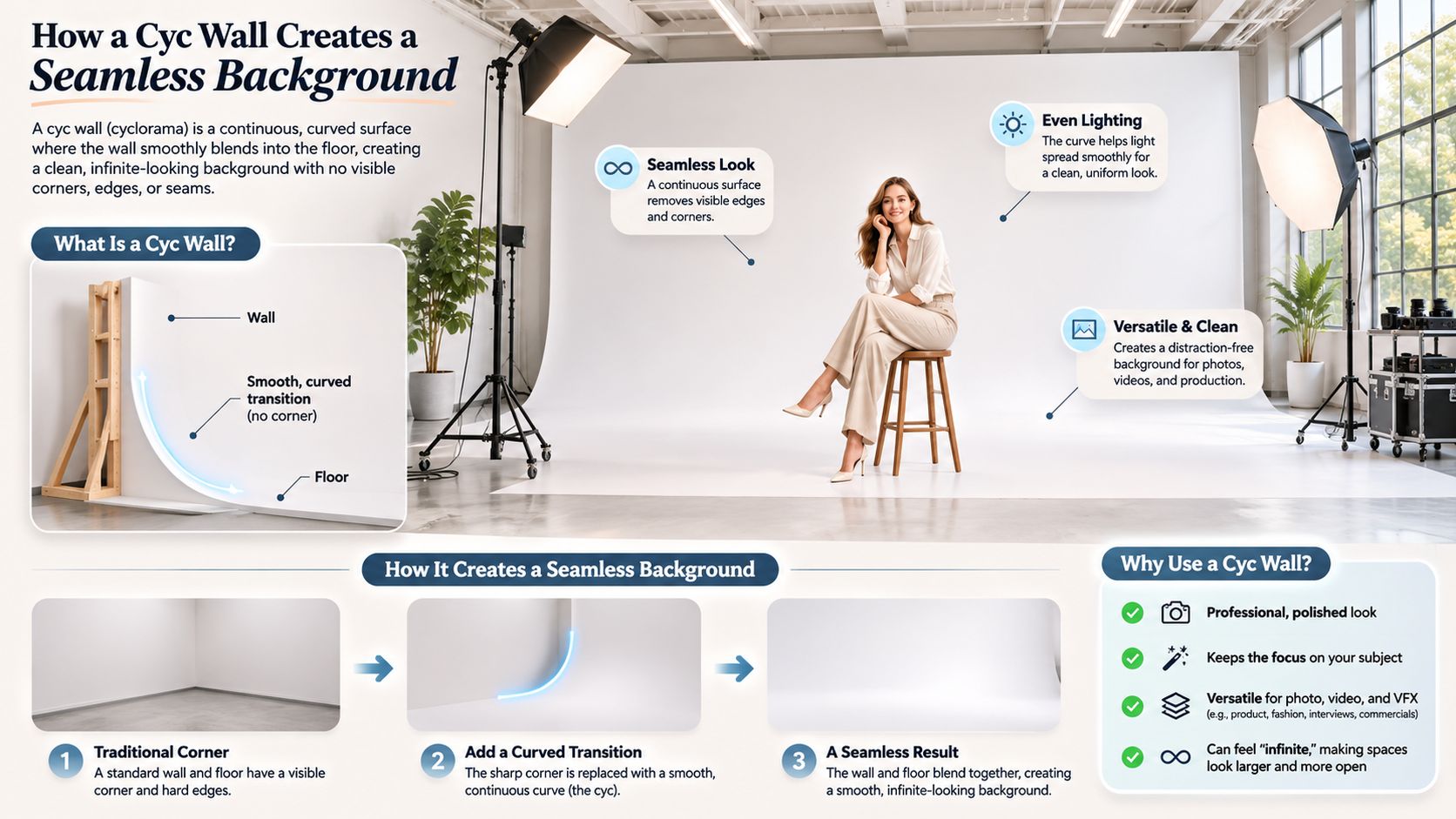
Say you're photographing a standing model and need the background to continue beneath their shoes. Against an ordinary wall, the floor junction becomes a visible line. Think instead of smooth paper curling gently from the floor upward: the camera can't easily identify where the horizontal surface becomes vertical.
That curved transition is the cove. The Flashboards cyclorama guide explains how it removes the visible right-angle junction so an evenly finished and illuminated surface reads as a continuous background.
What the camera actually records
The camera still records differences in brightness, texture, and shadow. A curved wall doesn't erase those differences automatically. If the cove receives less light than the upright wall, the transition becomes visible as a band.
Work from the intended camera position. A surface that looks continuous while you're standing beside the monitor may reveal a lighting gradient through a low-angle lens. Test the widest composition and the lowest planned camera height before approving the setup.
The missing hard corner gives the lighting crew a more forgiving surface. There's no sharp junction where shadows and abrupt brightness changes naturally collect, but fixtures still need careful placement.
A reusable surface, not an indestructible one
For renters, the practical advantage is a reusable production background instead of constructing a temporary setup for every project. The same principle serves still photography, commercials, narrative film, television, broadcast production, and virtual-set work.
Construction can involve curved plaster, stretched fabric, painted surfaces, or modular panels. Don't assume every cove can support the same loads or tolerate the same treatment.
Keep weight on approved areas. Confirm where props, wheels, and performers may safely go.
Protect the curve. Don't walk backward into it while watching a monitor.
Inspect through the lens. Look for seams, damage, texture, and unwanted floor reflections.
If a horizon-like line appears, adjust the camera position and lighting before blaming the wall. The geometry provides the opportunity for a polished image; the crew still has to create it.
Cyc Wall Rental Options and Studio Features
The useful rental options aren't just different colors. You're choosing between rooms with different shooting depths, rigging possibilities, access routes, and booking structures. A stage can look enormous in a listing photograph yet leave little usable space once the camera, talent, and background lights are positioned.
Start with your shot list and sketch the widest setup. Include the camera's working position, the performer's movement, lighting stands, flags, and a clear crew route. Measure the usable stage, not the building's total floor area.
Match the room to the setup
Usable cyc dimensions. Confirm uninterrupted width and height, including what remains outside the frame during camera moves.
Overhead clearance. Check whether diffusion, boom arms, and grid-mounted fixtures can sit high enough without entering the shot.
Shooting depth. Leave room to separate the foreground lighting from the background lighting.
Floor condition. Establish whether the surface arrives as is and whether your finish needs additional preparation.
Production support space. Dressing rooms, lounges, and gear staging keep preparation from spreading onto the shooting floor.
Access route. Check doors, turns, loading arrangements, and the path to the stage if vehicles or large props are involved.
Use a studio walkthrough to evaluate circulation as well as appearance.
Compare booking structures carefully
Hourly rentals can suit a tightly prepared shoot. Block bookings offer a defined window, but that window must accommodate whatever the agreement includes, not just camera time.
For a published comparison, Studio 615's cyc studio listing published 2025 rates of $1,400 for a 5-hour Sunday–Thursday booking and $1,600 for a 5-hour Friday–Saturday booking. Those are that studio's historical booking terms, not an Atlanta market average.
A cheaper room isn't cheaper if its layout forces the crew to rebuild the lighting for every camera position.
Match the color, dimensions, and access to the shot list before comparing rates. Ask for an equipment inventory rather than accepting “lighting available” as a complete answer.
Lighting the Cyc Wall and Keying Green Cleanly
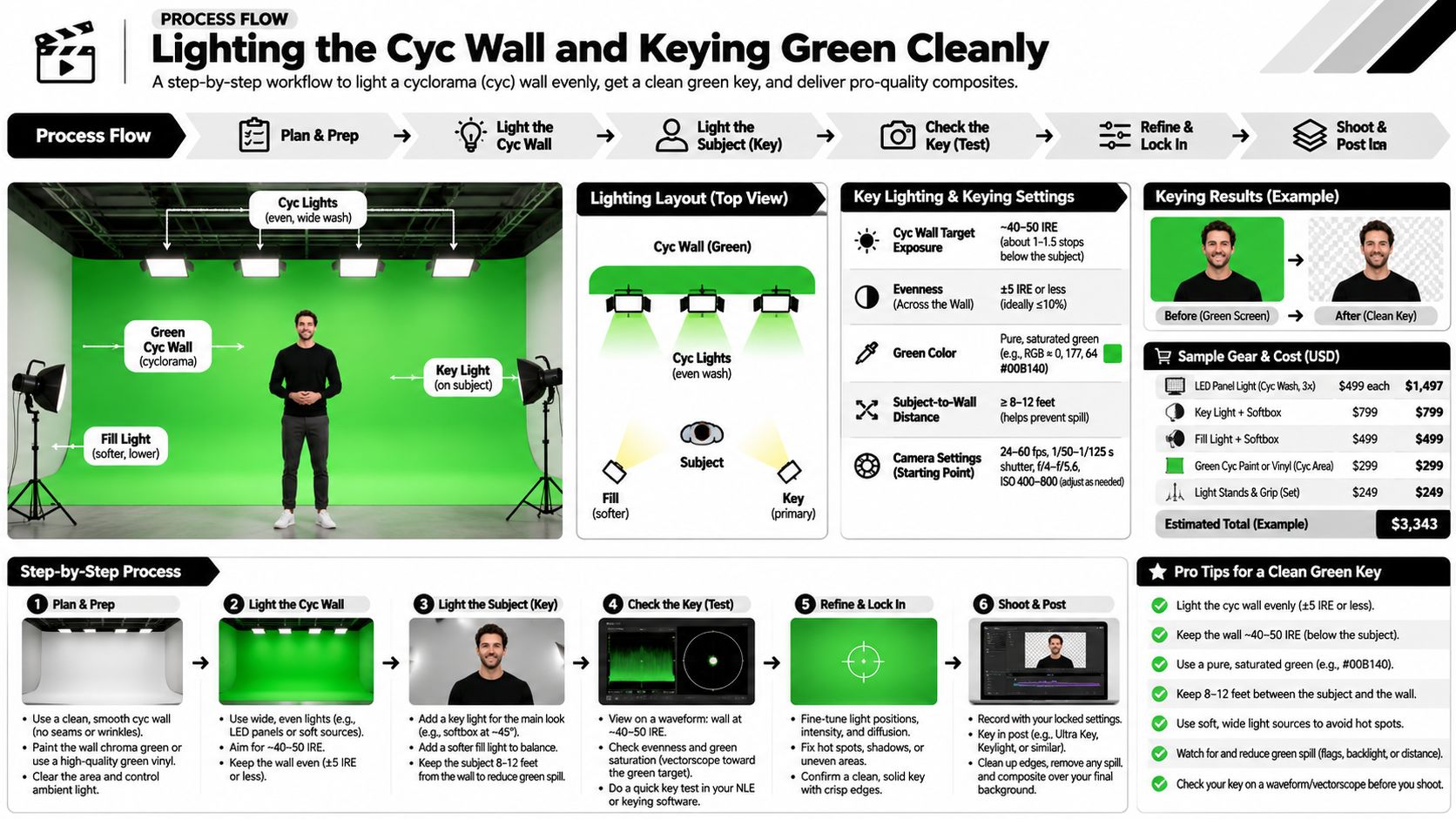
The camera is ready, but the white wall is still uneven and green spill is reaching the performer. Every minute spent correcting those problems comes out of the booked shoot. Separate background and subject exposure from the start so changes to one do not disrupt the other.
Build the lighting in a controlled order
Position the talent before placing fixtures. Use the planned blocking to establish distance from the cyc, then keep that space clear. Cases and spare stands that creep into the area can limit separation and make shadows harder to control.
Light the wall with broad, overlapping sources, such as strip lights or large soft fixtures. Feather their coverage together. A narrow beam aimed directly at the curve creates a bright patch rather than an even background.
Set the background exposure. For white, aim for a wall exposure 1–2 stops above the subject key. Stop increasing output once the background records cleanly. Excess light can wrap around shoulders and erase edge detail.
Use flags, cutters, or barn doors to keep background light off the talent and out of the lens. Check the beam path, including reflections from the floor.
Meter the visible surface before talent enters. Include the cove and floor if they appear in frame. Fix dark bands and hot spots at the fixtures rather than relying on post-production.
Light the subject last. Inspect hair, shoulders, pale fabrics, and reflective objects on the monitor, then recheck the wall with the subject lights on.
Lightz Out Studios' lighting guidance recommends placing talent approximately 3–5 m (10–15 ft) from the cyc where the room allows. Treat this as a starting point, then check the frame for shadows and spill.
Make green uniform before making it bright
The HowToFilmSchool cyclorama guide gives a practical target of within about one-third of a stop of variation across the camera-visible green area. Uneven luminance and color make extraction harder around hair, translucent fabric, and moving edges.
Green does not need the white-background exposure approach. Raising its output can increase contamination on skin and wardrobe without improving the key. Prioritize even coverage, then check the recorded color.
Lighting reference values for a cyc wall
Setting | Reference value | Why it matters |
|---|---|---|
Background brightness, white cyc | 1–2 stops above the subject key | Keeps the wall from recording gray without unnecessary overexposure |
Subject distance from cyc | Roughly 3–5 m (10–15 ft), where the room allows | Reduces cast shadows and background spill |
Green cyc exposure variation | Within about one-third of a stop across the visible area | Keeps the key stable across the frame |
Background fixtures | Broad, overlapping sources with flags or barn doors | Avoids bands and hot spots on the curve |
Exposure check before talent enters | Measure several points across the visible wall | Catches gradients before they reach post |
Test with the intended aperture, shutter, ISO, lens, and frame rate. Inspect the waveform for uneven background levels and the vectorscope for color consistency. If time allows, pull a rough key before approving the setup.
For a moving performer, test the full movement path, not only the starting mark. A clean stationary edge does not guarantee that flying hair or a fast hand movement will key cleanly.
Encore Film And Music Studio's guide to lighting green screen offers additional setup guidance. If the foreground looks dull or noisy, fix flat, noisy photos with lighting can help distinguish subject-lighting issues from background problems.
Before rolling, confirm wall evenness, talent separation, and spill control. A bright monitor image alone does not confirm that the background is evenly exposed or that the edges will key cleanly.
Budgeting a Cyc Wall Rental Beyond the Hourly Rate
A cyc rental budget needs to cover more than camera time. Include the booked hours, any fresh paint, equipment, insurance, transport, and the time needed to load in and out. A low hourly rate can still lead to a higher total if the setup needs extra services or time.
Decide early whether the production needs liability insurance. A studio may require coverage and a Certificate of Insurance, especially if the renter does not already have an annual production policy. The certificate documents coverage; it does not replace the policy.
Floor preparation is a separate cost only when fresh paint is needed. Encore's studio-rental guide lists charges of $100 for fresh white, $75 for fresh black, and $150 for Studio Green fresh Chroma Key Green. The cyc wall studio floor is provided as is, so include a paint charge only if the production needs fresh paint applied.
Build a quote-based worksheet
Mark each line as included, unnecessary, or separately charged. Use the figures below where applicable, then confirm which services and conditions apply to the booking.
All-in cyc wall rental cost worksheet
Cost line | When it applies | Typical cost or range |
|---|---|---|
Cyc wall rental | Every booking | $110 for 1 hour |
Production liability insurance | The production needs coverage | Obtain a policy quote and confirm the required Certificate of Insurance |
Fresh cyc paint | The production needs a fresh finish | $100 fresh white, $75 fresh black, or $150 Studio Green fresh Chroma Key Green |
Crew and overtime | Staffing or additional time is needed | Confirm crew charges and the applicable rental rate for extra hours |
Lighting and grip gear | Required equipment is not included | Request an itemized equipment quote |
Equipment transport | Gear comes from another location | Price vehicle, delivery, fuel, and handling as applicable |
Cleaning and restoration | Scuffs, debris, or damage require work | Confirm cleaning terms and any restoration charges |
Vehicle access | A vehicle must enter the stage | $85 flat fee |
Load-in and load-out time | Setup and teardown require room access | Include this time in the booked rental window |
Compare complete production days
For a music video with a vehicle performance setup and a realistic interior scene, compare the full cost of each option. A lower-cost room may require separate equipment delivery, additional load time, or another location and lighting setup. A better-equipped space may cost more to rent but reduce other production expenses. The actual package determines the difference.
List the room, gear, staffing, transport, setup, and location changes before choosing. Use the film-set lighting equipment checklist to identify missing fixtures and grip needs before requesting equipment prices.
Budget safeguard: Schedule setup and teardown before deciding how many shooting hours you can afford.
If the booking runs over, each extra hour is charged at the hourly rate that applies to the rental, subject to availability. Keep that possibility in the budget, especially when the schedule includes vehicle moves or a lighting change.
Request an all-in written quote that specifies what is included, optional charges, overtime terms, and conditions that trigger cleaning or damage costs. Keep routine preparation separate from restoration, so the agreement makes clear what the production is paying for.
When a Physical Cyc Beats an LED Volume
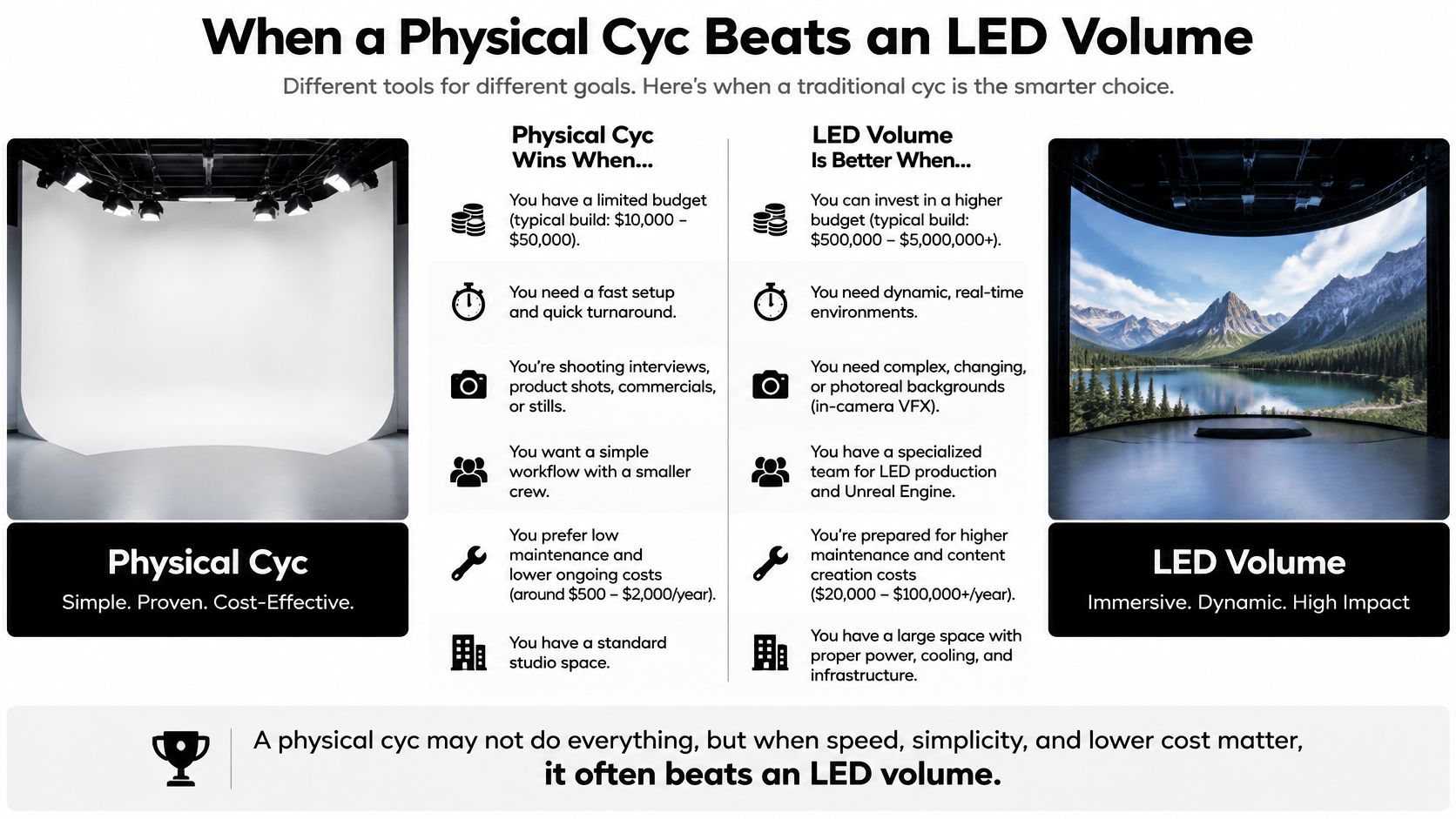
Newer technology isn't automatically the better rental choice. An LED volume can display an environment during capture, while a physical cyc gives the crew a surface to light or replace later. Choose between those workflows by what the shot needs, not by which stage looks more impressive on a tour.
The DataIntelo LED-volume market report estimates a global market of $2.8 billion in 2025 and projects $5.9 billion by 2033. Growth in that market doesn't establish that an LED stage is the right expense for an independent production.
Compare the work each stage requires
Physical cyc vs LED volume by production need
Option | Best for | Main tradeoff | Cost signal |
|---|---|---|---|
Physical cyc | Controlled lighting, economical wide shots, green-screen compositing, rehearsals, music videos | Spill, keying, and floor scuffs need active management | Rental booking, equipment, and surface preparation when needed |
LED volume | Real-time reflections and environment backgrounds | Moiré, refresh-rate compatibility, and content preparation | Specialized stage, playback workflow, technical staff, and environment content |
LED can help when a background needs to appear in reflective surfaces during capture. But the production must prepare suitable content and test the camera against the display. Moiré can appear when the camera resolves the panel structure, while timing incompatibilities can create visible artifacts.
A physical cyc avoids display-related issues, but it doesn't remove production work. Green shifts responsibility toward extraction and compositing. White requires intentional shadow and reflection control. Black requires disciplined containment of stray light.
Choose by the difficult part of the shot
For an interview with a clean graphic background, a physical cyc is a straightforward choice. You can prioritize flattering faces, sound, eyelines, and consistent framing without preparing a digital environment.
For a dance rehearsal or performance capture, prioritize safe usable floor space, movement coverage, and a lighting rig that stays outside the action. An LED background adds little if the final image doesn't need an environment.
A car scene that depends on moving environmental reflections is a stronger reason to investigate LED. Even then, compare a camera test and complete workflow quote against a physical-stage approach using controlled reflections and compositing.
Book the simplest stage that solves the hardest visual requirement. Don't pay for a display system when the actual deliverable is an isolated subject against a clean field.
Confirm Cyc Wall Rental Details Before You Book
A booking should settle the production plan, not leave the expensive decisions for arrival. Send enough information for the studio to understand the widest shot, the equipment footprint, and any unusual access requirements.
Use this checklist before making payment.
Confirm the color and floor condition. Specify whether the floor appears in frame and what finish the image requires.
Separate fresh paint from restoration. Decide whether you need a freshly painted surface before the shoot, and understand your responsibility for returning the studio in its starting condition.
Get the rental window in writing. Include access, setup, recording, and teardown, along with the dates and time slots covered.
Itemize production requirements. Record the treatment of vehicle access, sets, lighting, grip, and any equipment rented on site. On-site equipment payment is due at booking.
Confirm the reservation. Ask for written confirmation identifying the reserved space and agreed services.
Give the studio a usable brief
Our Atlanta facility offers over 10,000 sq. ft. of creative production space with white, black, and green cyc walls, vehicle access, and lounges. Cyc walls cost $110 for 1 hour. We set aside the facility for the client when a booking is made and don't overbook.
Use our studio-booking guide to prepare your request. Include the shot list, chosen color, crew footprint, camera movement, equipment needs, and access plan.
For keyed footage, arrange a lighting test around the actual capture settings and movement. A short, purposeful test is more useful than discovering an unstable edge after the crew has wrapped.
Encore Film And Music Studio offers white, black, and green cyc walls, production space, and on-site equipment rentals for Atlanta photo, film, and music-video shoots. Visit Encore Film And Music Studio with your shot list and color choice to request a written all-in quote and arrange a lighting test if your footage will be keyed.


Comments